This post is different. It won’t detail an adventure in London, or even make you laugh, but will instead focus on a list: A guilty pleasure list.
At the end of each year, there are always hundreds of countdowns published by various media outlets detailing their choices for the best albums or songs of that 365-day period. And year after year, I find myself hating these lists more and more. But by being in a new city, I’ve been getting asked recently what my favorite music is by different people I’m becoming friends with. That has had my mind wandering around for the past weeks. I’ve done some thinking, and would like to present to you my Top Five Favorite Albums.
I thought about the criteria for what should go into such a small list from such an expansive amount of choices. What does an “album” really require, be it an LP, EP, double album, or compilation? Can I choose more than one by the same artist? Small or major label? It was not as simple of a task as I thought it would be. At first, I thought of picking the albums from the names I’ve been listening to the longest, like Foo Fighters. But that didn’t seem right in this case- “favorite artists,” in my opinion, is very different than “favorite albums.”
After a while, there was too much to choose from. Then, I thought, “fuck it.” This is my list, and these are the albums that have either heavily influenced some aspect of my life or have been influenced on me by someone I value. The only real criterion is: no skipping. It’s got to be a record you love from start to finish.
This list is not in any particular order. If you agree or disagree, know this: I don’t care. Feel free to discuss or write your own list in the comments. Also, do both you and I a favor and don’t scroll down the list just to see the selections. You’ll cheat us both of the pleasure.
(Note: I hate when I read music reviews that use adjectives that are better used to describe food than music. Don’t know what I mean? Pick up any recent issue of Rolling Stone. You will see none of that shit here. I wrote this out in pretty simple terms, so you don’t need to have a huge knowledge of theory to understand what I’m getting at.)
Consolers of the Lonely by The Raconteurs
Jack White was one of the biggest names in music in the 2000s. “The White Stripes” and “Seven Nation Army” became household terms. But of all the music that Jack White has released, the most intricate of all his works gets left out of nearly every discussion. This is the second album by the modest “supergroup” that White was a part of known as The Raconteurs. Comprised of four men from the American Midwest, the group thought of themselves more as a bunch of friends who wanted to play music together than a supergroup. In 2006, they released their first album, Broken Boy Soldiers. The lead single “Steady, As She Goes” is probably the only song from it that rings a bell. It was an interesting change of direction from the steady drum and guitar releases put out by The White Stripes, and put the names of a few other good musicians out there. A year later,Icky Thump, the final album by The White Stripes, was released to much publicity and fanfare. The opposite held true in 2008, with the surprise release of the second album by The Raconteurs, Consolers Of The Lonely.
The first Raconteurs album never did it for me (but grew on me last fall), so I didn’t bother with this album until March 2010. Two months earlier, my great childhood friend and aspiring musician, Jake Saleh, made the recommendation to check it out. In his own words, this second album “puts the first album to shame.” I picked up Consolers soon after, but never listened to it until March. My first experience with it was not a pleasant one; it was a middle-of-the-night drive to my aunt’s house after I received word that my uncle had died without warning of a heart attack. I needed something to keep me awake, and due to the emotional circumstances of the situation, I did not really feel like listening to anything I was familiar with. Somehow, I came to this album.
Each playthrough of Consolers makes me think of my late Uncle John. Even with the initial memories attached to it, I love every bit of this album. With its rock roots influenced by the bluegrass and country styles from some of the band members’ past, this album stands in a category of its own in the Jack White discography. Just by taking a look at the album art- a black and white photo of four men, a blindfolded woman, and a child surrounded with birds all presented on a float that looks like it was taken right out of Tom Sawyer’s Missouri, while proudly displaying the three states the members of the band call home- and you’ll notice that this is going to be a foray into something you’d find difficult to call “familiar.” Take note of the way the four musicians stand- stoic and quietly holding their instruments. They aren’t here to cause a scene. Dressed in southern suits, their appearance compliments their name- they’ve come to tell you stories.
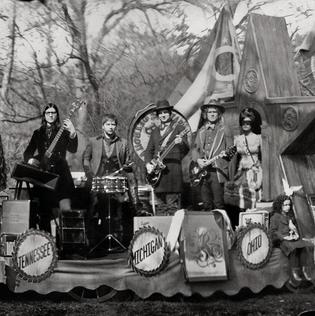
The storytelling is a great mix of rock, moderate blues, and bluegrass. The first track, the eponymously named “Consoler Of The Lonely” will knock you off your ass. The opening of a group of friends casual laughter and a little girl’s request of “Daddy, will you tell me a story?” is answered by a sharp, biting guitar riff, followed by a commanding drum line informing you that this shit just got heavy. The triple-track melodic vocal led by Brendan Benson is succinct and smooth. He is answered by an edgy and chilling White, which is brought right back to the second Benson verse. The tone of the song is sympathetic and desperate, leading you to realize that this is a new phase for the storyteller. Concluded with a phat bass riff bridging to the song’s all-out jam, this introduction to the album leaves nothing to spare.
“Salute Your Solution” is another rocky, pumping, loud listen that makes you want to bob your head to the pedal of the bass drum. And it has another killer bridge in it. After that, the album slows it down and the country roots start to show. The third and fourth tracks, “You Don’t Understand Me” and “Old Enough,” are another departure from the prototypical Jack White. “Old Enough” in particular strikes me for its blend of country-inspired vocals, fiddle, steel guitar, and perfectly integrated bass and drum. The middle tracks- “The Switch And The Spur,” “Hold Up,” “Top Yourself,” “Many Shades Of Black,” and “Five On The Five” continue the tales and will take you to another place and time. I always start thinking of the American Southwest during these tunes. The passion in Benson’s lead vocals during the tale contained in “Many Shades Of Black” is unique all to itself.
The album’s highlight track is by far “Attention.” A song about a conundrum that we can all relate to at some point- looking at yourself in the mirror- is a concept that this story digs far deeper into. The bass is heavy, the chords are simple and catchy, and the drum is nonstop perfection. This is absolutely my favorite track on the album. It takes a simple note structure around four power chords and adds and subtracts from them in such intriguing ways, but the combination of it all makes it so much more.
“Pull This Blanket Off” is a nice comedown, and “Rich Kid Blues” is a sad tale with a sweet organ solo between the dual voices of Jack and Brendan. “These Stones Will Shout” has a lead vocal reversal, and is an upbeat crescendo to the album’s final song, “Carolina Drama.” The last track is unlike any of the first thirteen. It truly is simply a story with a complimentary soundtrack to it. Jack sings the disparaging tale of a family in South Carolina that, admittedly, has no point and may not have an end. I won’t tell you the synopsis, but I will tell you that it’s worth listening to fully more than once.
Honestly, I did not anticipate writing this much for Consolers Of The Lonely, but I guess that shows how much I really enjoy it. I hope that, more than any of the other four albums on this list, you put this one on your playlist as soon as you can. Due to the storytelling nature of the album, its meaning will change from person to person. Don’t be afraid to tell your own story about the album after you hear it.
Are You Experienced by The Jimi Hendrix Experience
Trying to pick one of the three Experience albums is like a woman trying to pick her favorite cut of a diamond. The first album I heard was Hendrix’s historic Electric Ladylandback in middle school. My dad and I went out for a Saturday afternoon trip to Best Buy and he wanted to show me some music. I don’t remember what else he bought that day, but when he picked up Electric Ladyland he said something along the lines of, “This is the best guitar album ever made. It will change everything you know about music.” He was right.
Going backwards, you’ve also got Axis: Bold As Love. Although it contains my favorite Experience song, “Bold As Love,” the album doesn’t rank as high as the other two.
I chose the Jimi Hendrix Experience’s debut album for different reasons. First, it’s a fucking great album. The songs are so well written for a debut album, and they absolutely stand the test of time. The lyrics are relatable (and incredibly underrated), and obviously the guitar work is prodigious. Noel Redding plays some great bass, especially on “Manic Depression,” and Mitch Mitchell proves his might as one of the best drummers of all rock history. Simply listen carefully to his parts in “Fire” and “Can You See Me” and you’ll agree. Overall, the songs are all independently awesome, as fifty years later people are still trying to figure out what was incubating in Hendrix’s head and how to emulate it.
A deeper reason as to why I chose this has to do more with the time and place in which it was written. Back in 1966, barely anyone in the U.S. had even heard of Jimi Hendrix. Despite playing around the country for years before that, no one ever gave a damn about him until Chas Chandler brought him to London. At that time, most people couldn’t see past his physical appearance- his clothes, his hair, and most notably, the color of his skin. When he got to London, people didn’t see that. This allowed him to truly get comfortable with himself and his creativity. Despite never being confident in his vocal abilities, Jimi Hendrix was able to express himself lyrically in imaginative ways that were on par with The Beatles. Speaking of, Are You Experienced was released just two weeks before Sgt. Pepper’s Lonely Hearts Club Band, and held the #1 spot on the charts until its release. But there was no bad blood between the groups. If it weren’t for Paul McCartney being a supporter of Hendrix, we’d probably never had heard his work. The respect was mutual, for two days after the release of Sgt. Pepper, The Jimi Hendrix Experience covered of “Sgt. Pepper’s Lonely Hearts Club Band” in front of a live crowd in which The Beatles were in attendance. And they loved it.
Are You Experienced is a staple in rock, blues, psychadelia, racial adversity, guitar, and the creative spirit. How many riffs are as iconic as the opening of “Purple Haze?” It’s an album that is as timeless as it is mysterious. And for all of the reasons, it has solidified its place on my list.
Mellon Collie and the Infinite Sadness by The Smashing Pumpkins
When I was in second grade, my big Christmas gift was a stereo with FM/AM, tape deck, and brand new CD player. To initiate my CD collection, my mom gave me the Chicago Bulls Greatest Hits: Volume 1 (there would later be a Volume 2) and the soundtrack from Space Jam. Michael Jordan was in his prime back then (note: both of these compilations still rule). My dad, on the other hand, gave me two real albums. The first was Metallica’s Load. I hated it then, and I still hate them now. He and I both learned then that I was not made for metal. The second album was much more sophisticated and enigmatic. It was The Smashing Pumpkins’ hugely successful follow-up to their breakthrough Siamese Dream. It was the 28-track double album Mellon Collie and the Infinite Sadness.
I don’t think I’ll ever understand the cover art, or the contents of the images within the insert. They’re paintings of rabbits as people in a Victorian setting. It was also the first album I ever got that contained the lyrics in a separate insert inside the package. More albums should do that.
This is the only album that I don’t ever get tired of hearing. Every time I put it on, it’s a new listen for me. Though I know where to pick out some of my favorite tracks, I don’t have the track listing memorized. It’s also the only album I have where I’ll physically insert the CDs into my computer or stereo to play. I can’t explain why, but I prefer it that way. It’s an experience.
All aspects of this album continually surprise me. When I look inside the package, I’m as perplexed as I was before my balls dropped. Some of the songs are just absolutely fucking killer when I listen to them, like “Jellybelly.” Others take me back to a memory of somewhere in Chicago riding around the city with my dad at his work. Sometimes I think of all those times when I had this playing when I was trying to finish some assignment in high school. But, some of these songs are always fresh to me. For example, I never really appreciated “Bodies” until this year. Jimmy Chamberlain is a rhinoceros of a drummer. He’s not only powerful and quick, but everything he plays with his sticks on this album was recorded perfectly with Billy Corgan’s songwriting style. This album exemplifies him as what it takes to be one of the greatest drummers to ever play. I mean it. He’s noticeably absent from lists that name John Bonham, Neil Pert, Dave Grohl, or even Mitch Mitchell as the greatest drummers of all time. That’s not fair, because he really deserves so much more praise for what he has done.
And what can be said about Billy Corgan? People have their own thoughts about how he acted back in the Pumpkins’ prime, but the range of his voice is diverse and mighty. From low to high pitch, this guy can really wail. The effects of his guitar on some of the songs, like “Love,” can’t be imitated. The sharp and drastic use of different effects on his axe make me want to try to make the same sounds. But it can’t be done.
The album’s first track, “Mellon Collie and the Infinite Sadness,” is probably not what anyone expected to hear when he or she played the album for the first time. But you have to admit how easy it is to see its beauty. It is one of the only songs I can play on piano and not fuck it up.
Corgan might have been a depressed weirdo, but he really knew how to make some powerful, touching songs. The Smashing Pumpkins’ history is full of drama and convoluted, but this album is their finest work, and my favorite album I’ve heard so far. I value this album for my shared connection with my father, and I’m glad that I still find something new in every play, because I will never tire of it.
A Hard Choice
There are two distinct forms of Red Hot Chili Peppers (RHCP). Everything before Blood Sugar Sex Magik is “classic,” and that and everything that follows is “modern.” Modern RHCP is what you hear on the radio, except for “Higher Ground,” which was made exclusively for the Power Rangers movie (that’s a lie).
There is one key feature that causes this differentiation: John Frusciante, the band’s guitarist. Look at the albums he played with them on, and you can see by sales alone what a difference he made. “Made,” you see, because he left the band (for a second time). And look at what they did without him: that piece of shit with Dave Navarro, One Hot Minute(minus “Aeroplane.” Props to Flea.).
Californication is probably their biggest and most successful album. But is it their best? Not in my opinion. That is a fair call between By The Way and Stadium Arcadium. The greatness in these two albums among the rest of their discography lies within Frusciante’s abilities- but not as a guitarist. It is his background vocals that are the true difference maker. Yes, his guitar work is fantastic. That is something I will not dispute. But without his vocal contribution, these albums wouldn’t have the kaleidoscope of colors I hear every time I turn them on.
Don’t understand what I mean? Go back and listen to “Universally Speaking,” “Dosed,” “The Zephyr Song,” “Midnight,” “Cabron,” “Tear,” “Minor Thing,” and “Venice Queen” onBy The Way, and any of the twenty-eight tracks on Stadium Arcadium. Take note of his voice, and then imagine if it wasn’t there at all. The songs would only seem half-full.
With that in mind, I had to choose. By The Way is a beautiful album. The song writing is elegant and complex. You’ve got your hard radio-heavy singles in “By The Way” and “Can’t Stop” while also having your light and lovely pieces like “Tear” and “Cabron,” with songs you don’t know how to classify in between, like my favorite, “Minor Thing.”
Stadium Arcadium by Red Hot Chili Peppers
Despite these awesome qualities, I had to go with Stadium Arcadium. No doubt a gazillion-copy selling album, I favor Stadium Arcadium for the tracks you wouldn’t remember among its hits “Dani California,” “Snow ((Hey Oh)),” and “Tell Me Baby.” My favorites that I will never tire of are “Stadium Arcadium,” “Torture Me,” “Especially In Michigan,” the slow and sad “Wet Sand,” and that’s only the first disc, Jupiter. Disc two, Mars, keeps the treasures coming in the loving “Hard To Concentrate,” the phat stomp of “21st Century,” “If,” “Make You Feel Better,” “Animal Bar,” “So Much I” (the last three can be continuous three-song punch on any album), “Turn It Again,” and the funeral ballad to Flea’s dog that is “Death of a Martian.”
Stadium Arcadium was huge, and even though bigger is not always better, the album certainly doesn’t fuck around. I must point out that John Frusciante is not the sole benefactor of my praise; Anthony’s vocals are smooth throughout, despite being nearly always nonsensical. Flea’s oftentimes melodic basslines are just powerful and invigorating, and Chad Smith’s drums hold steadfast in every song, still making him a standout among rock’s best.
It’s a shame that John Frusciante again left the band after this album’s tour. I’m excited to hear RHCP’s next endeavor due later this year, tentatively titled Dr. Johnny Skinz’s Disproportionately Rambunctious Polar Express Machine-Head, but after Stadium Arcadium’s testament to the originally creative yet still mainstream band, I can’t help but feel a sense of loss. Best to go out on a high note.
And finally,
The Temptations: All the Million-Sellers by The Temptations
For the last album, I had to search deep within my soul and find my true colors. They lie within The Temptations: All the Million-Sellers.
I’d like to keep it simple for this one.
I was born forty years after Motown was pumping the hits, but these songs will never get old. I was put on to The Temptations at an early age, sitting in the back of my mom’s old blue Volvo, driving to the beach during the Chicago summers with the windows down and the speakers cranked to Oldies 104.3 with Dick Biondi all the way. These songs will always remain timeless. They serve as both an introduction to and the foundation of Motown Records. Just the names of the songs “My Girl,” “Ain’t Too Proud to Beg,” “I Can’t Get Next to You,” and even “Papa Was a Rollin’ Stone” put a smile on my face and make me want to get up and dance. There are a few notable Temptations hits missing, like “Get Ready,” “The Way You Do the Things You Do,” and “Beauty Is Only Skin Deep,” but like I said, this also serves as an excellent introduction for anyone to Motown. And it was exactly that to me as a child.
Honorable mentions go to:
There Is Nothing Left To Lose by Foo Fighters
Weezer (Blue Album) by Weezer
Showbiz by Muse
Stankonia by OutKast
blink-182 by blink-182
Death Wave by Hemmingbirds
R by Queens Of The Stone Age
Oh No by OK Go
The soundtrack to Michael Mann’s 2004 Collateral (Odd choice, I know.)
If you made it this far without jumping through the sections, I thank you. And if you skipped through, I ask you to scroll back up and try again.
This was a very different kind of writing for me, and again, I want to thank you for reading. I hope you enjoyed this post, and enjoy hearing the albums, as much as I have.
 Eliott At Large
John Bonham*